
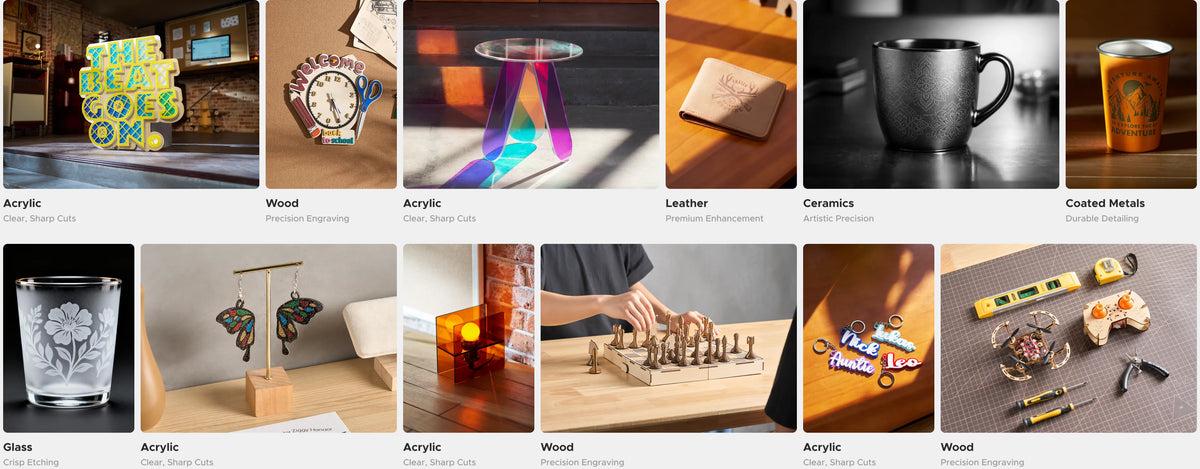

From the “sandstone” universities of the Group of Eight to the cutting-edge technical hubs in Melbourne and Brisbane, the Australian higher education landscape is undergoing a manufacturing renaissance. As we move through 2026, OMTech laser engravers have become the “workhorse” of the campus makerspace, bridging the gap between digital design and physical reality.
While 3D printing is excellent for conceptual shapes, Australian engineering and architecture faculties are increasingly relying on CO2 lasers for their high-speed throughput, structural reliability, and sub-millimetre precision. Here is how Australia’s future innovators are using laser technology to push the boundaries of design.
Solving Real-World Problems in the Australian Context
Australian universities play a critical role in the nation’s “A Sovereign Capability” goals. Laser technology is essential to this mission:
- Renewable Energy & Agri-Tech: Students in regional hubs use lasers to prototype components for solar-tracking arrays and robotic sensor housings for smart farming. The ability to cut UV-stable Acrylic and high-density MDF allows for field testing in harsh Australian environments.
- Sustainable Architecture: Architecture students at UniMelb and USYD use lasers to create intricate 1:200 scale models of sustainable “green buildings.” Using the vector cutting feature, they can replicate complex louvre systems and facade textures that are too delicate for traditional hand-modelling.
- Biomedical Research: In Australia’s thriving med-tech sector, university labs use lasers to create “Lab-on-a-Chip” prototypes—microscopic channels etched into medical-grade acrylic for rapid diagnostic testing.
Managing a Professional Campus Lab
For Australian lab managers and technical officers, establishing a safe, efficient workflow is the foundation of a successful makerspace.
Phase 1: The “Digital-to-Bench” Pipeline
Most Australian engineering departments standardise on SolidWorks, Autodesk Fusion 360, or Rhino.
- LightBurn Software: LightBurn is the “gold standard” for Australian labs due to its robust “Material Library.” Technicians can pre-set parameters for Australian Hoop Pine or Tasmanian Oak veneers, ensuring students achieve a perfect cut without wasting expensive local timber.
Phase 2: The “Cardboard First” Prototyping Rule
To align with sustainability initiatives (and protect departmental budgets), many top-tier Australian labs enforce a “Cardboard First” policy. Students must prove their design’s structural integrity using cheap, recycled corrugated cardboard before they are granted access to premium materials like cast acrylic or hardwoods.
Phase 3: Safety & Compliance (AS/NZS Standards)
Australian university labs operate under strict WHS (Work Health and Safety) regulations. This includes:
- Effective Fume Extraction: Ensuring all particulates and VOCs are filtered or exhausted according to local environmental protection standards.
- Laser Safety Officer (LSO): Every lab typically designates an LSO to ensure all users wear appropriate PPE and understand the “Never Leave the Machine” rule.
- Optic Maintenance: Teaching students to clean lenses and mirrors daily to maintain the 025mm tolerance required for senior engineering projects.
Academic Project Matrix: Australian Curriculum Integration
| Level | Department | Core Concept | Project Example | Material |
| Year 1 (BEng) | Design & Tech | Spatial Visualisation | Interlocking 3D “Flat-pack” Structures | MDF / Cardboard |
| Year 2 (BEng) | Mechatronics | Mechanical Assembly | Custom Robot Chassis & Gear Trains | Acrylic / Delrin |
| Senior (Honours) | Aerospace Eng. | Weight-to-Strength | UAV Wing Ribs & Internal Bracing | 3mm Birch Plywood |
| VET / TAFE | Product Design | Commercial Finishing | Bespoke Signage & Branding | 6mm Timber Veneer |
Preparing the Workforce: Skills for the “Modern Manufacturing” Era
By integrating OMTech lasers, Australian universities are producing graduates ready for the global stage:
- Understanding Kerf & Tolerances: Students learn that the laser beam has a physical width (0.2mm). Learning to compensate for this is a vital skill in precision manufacturing and CNC operations.
- Material Literacy: Graduates understand the chemical properties of materials—why Acrylic creates a “polished” edge while PVC releases hazardous gases—a critical safety skill for industrial management.
- Project Documentation: Managing machine schedules, DXF file versions, and material sourcing replicates the high-pressure workflow of a professional Australian design consultancy.
Lab Manager’s Efficiency Checklist
- Custom Jigs for Campus Branding: If the university needs 200 custom trophies for an “O-Week” event, have a student assistant design a “jig” (template). This allows for rapid-fire engraving with perfect alignment every time.
- Tube Life Management: Use the digital ammeter on your OMTech to ensure the laser isn’t being “over-driven,” significantly extending the life of the glass tube—crucial for managing university maintenance budgets.
- Rotary Attachment Potential: Ensure the lab is equipped with an OMTech Rotary Axis for students designing cylindrical components or bespoke branded merchandise for university sports clubs.