
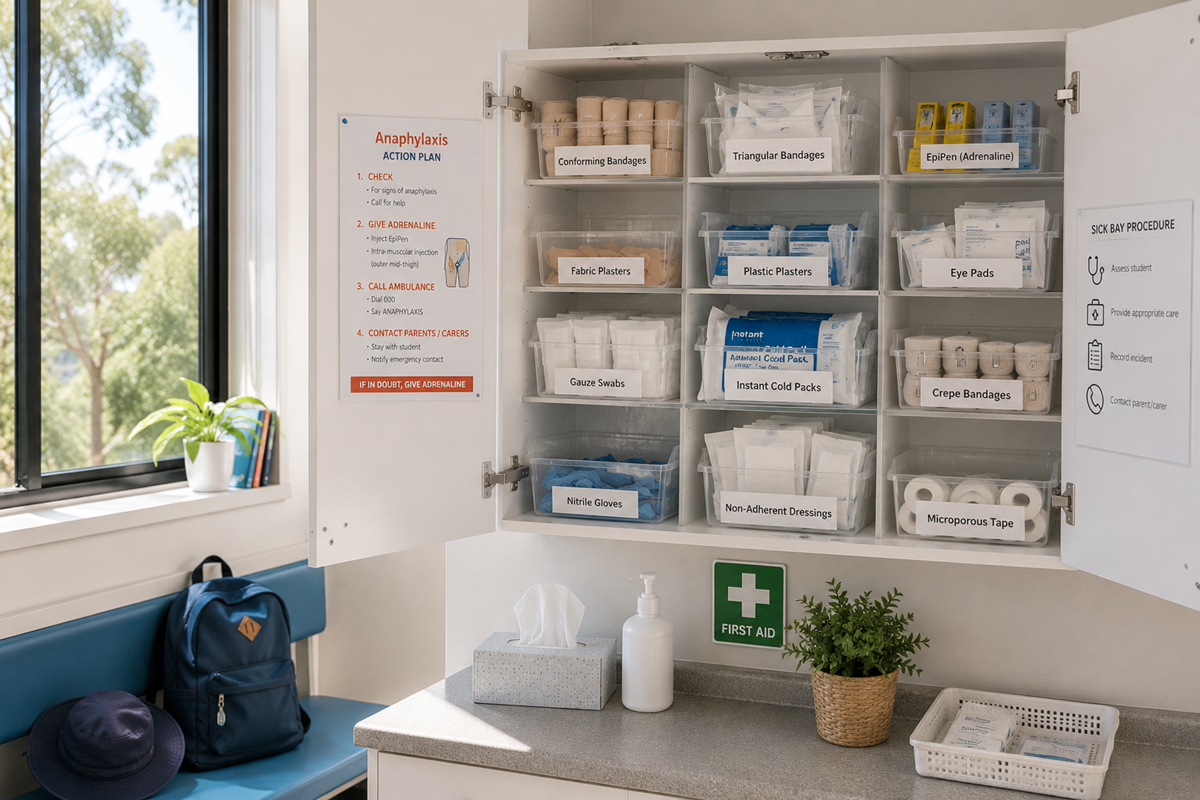

School first aid kits are not just a box of bandages in a cupboard. For Australian schools, they are a practical risk control that has to work in classrooms, playgrounds, sport, excursions, science labs, and staff areas without slowing anyone down.
The problem is that many schools still buy a generic kit and assume it covers everything. It usually does not. A school kit has to handle minor injuries, but it also needs to support asthma response, anaphylaxis readiness, and enough portable stock to match how the campus is actually used.
That is why the right school first aid supplies are best chosen by use case, not by price alone. A good kit is the one staff can reach quickly, use confidently, and restock without guesswork.
What school first aid kits need to do
A school kit has to do more than cover paper cuts and grazes. It needs to support rapid first response in a setting where injuries are predictable, movement is constant, and staff often need to treat more than one person across different locations.
The real job of a school kit
- Handle minor wounds, sprains, burns, and eye incidents
- Support asthma and anaphylaxis response where required
- Stay accessible in busy locations, not buried in a locked cupboard
- Travel easily for sports days, camps, and excursions
- Make restocking simple so the kit stays usable after each incident
Why generic kits fall short
| Generic kit | School-ready kit |
| Focuses on low-frequency home or office incidents | Built for repeated daily use across high-traffic areas |
| Often under-scales for excursions and sports | Includes portable options such as bum bags and backpacks |
| May ignore medication response needs | Can support asthma and anaphylaxis readiness |
| Hard to restock consistently | Designed for easier audit and refill cycles |
For schools, that difference matters. The kit is not just there to meet a checklist. It is there to reduce response time when a child falls, a finger is caught, or a staff member needs immediate access to an emergency supply.
What should be in school first aid supplies
The contents should reflect the most common school incidents first, then the higher-risk scenarios that schools are expected to plan for.
Core contents most schools need
- Adhesive dressings in assorted sizes
- Gauze swabs and wound dressings
- Conforming and crepe bandages
- Antiseptic wipes or cleansing solution
- Disposable gloves
- Scissors and forceps
- Saline or sterile water for eye wash and irrigation
- Instant cold packs for sprains and bruises
- CPR face shield or resuscitation mask
- Incident report pad and pen
Items schools often overlook
| Item | Why it matters |
| Spare dressings and bandages | High-use items disappear fast in schools |
| Portable packaging | Essential for yard duty, sport, and excursions |
| Clear instructions | Helps casual staff or relief teachers respond correctly |
| Refill stock | Keeps the kit functional after the first incident |
| Weather-resistant storage | Important for outdoor use and travel |
For asthma and anaphylaxis response
Some schools also need dedicated supplies for asthma and anaphylaxis management, including reliever medication, spacers, and adrenaline auto-injectors where permitted and required by policy. Those items should be stored and monitored according to the relevant state or school procedure, not mixed into a general kit without a system.
That distinction is important. General wound care stock solves everyday injuries. Emergency medical supplies solve the events that can escalate fast if staff have to search for the right item.
How schools should choose the right kit
The best kit is the one that fits the school’s actual movement pattern and risk profile. A primary school with busy yard duty has different needs from a secondary campus with labs, trade spaces, and regular excursions.
A simple buying framework
- Map the locations where first aid is most likely to be needed
- Match kit size to use such as central storage, yard duty, sport, or excursions
- Check whether specialist supplies are required for asthma, anaphylaxis, or sports injuries
- Choose packaging staff can carry and reopen quickly
- Plan refill stock before the first incident happens
Common kit formats for schools
| Format | Best for |
| Soft pack | Classrooms, portable response, and smaller campuses |
| Metal cabinet | First aid rooms and central storage |
| Bum bag | Yard duty, playgrounds, and quick-response use |
| Backpack | Excursions, camps, and sporting events |
| Refill pack | Keeping an existing kit audit-ready |
The wrong choice usually shows up after the first busy week. If staff cannot carry it, find it, or restock it quickly, it is not really a school kit. It is just inventory.
Compliance and maintenance
Even a strong kit becomes useless if it is not maintained. Schools should treat first aid supplies as a live system, not a one-time purchase.
What needs regular checking
- Expiry dates on dressings, medication, and consumables
- Missing or used items after incidents or sports events
- Packaging that has cracked, split, or been contaminated
- Whether portable kits are being returned and restocked
- Whether specialist response items are still aligned to current policy
Why maintenance matters
| Maintenance task | Practical impact |
| Monthly visual checks | Stops stockouts before they become a problem |
| After-use restocking | Keeps the next responder prepared |
| Expiry audits | Reduces waste and avoids unusable stock |
| Location reviews | Makes sure kits stay in the right places |
| Staff refreshers | Improves confidence and response speed |
A well-maintained kit does two things at once. It supports compliance, and it makes the first response faster. Schools that get this right do not just buy safer supplies. They build a safer workflow around them.
Conclusion
School first aid kits only work when they are chosen for the way a school actually operates. That means thinking beyond a standard box and building for classrooms, playgrounds, sport, excursions, and emergency response.
The practical test is simple. If staff can reach the kit quickly, find what they need without hunting, and restock it without friction, the kit is doing its job. If not, the school is carrying something that looks prepared but does not perform when it matters.
For schools reviewing their stock now, the smartest move is to start with the basics, add the specialist supplies the site genuinely needs, and keep a refill plan in place from day one. Browse LFA First Response’s range of school first aid kits to find the right fit for your campus.