

Bin liners are the product nobody thinks about until one fails. And when one fails, it fails memorably: a split bag of kitchen waste across a loading dock, a leaking liner dragged through a corridor, a workshop bin double-bagged because nobody trusts a single liner to hold. Businesses respond by buying “stronger” liners — but strength without sizing knowledge just means paying more for bags that still don’t fit the bin or suit the waste.
The truth is that liners are a genuinely technical product hiding behind a boring name. Micron thickness, material type, capacity and bin-fit all determine whether a liner does its job, and matching those specs to your actual waste is the difference between a liner that costs cents and works, and one that costs more and fails. For any business sourcing a bin liner perth suppliers stock in commercial quantities, here’s the working knowledge that makes the buying decision simple.
Strength: What “Heavy Duty” Actually Means
Liner strength comes down mostly to two things: the thickness of the film (measured in microns) and the material it’s made from.
Thickness in Practice
- Light duty— thin film suited to office paper waste, bathrooms and light rubbish. Cheap per unit, and perfectly correct for the job; using heavy film here is pure waste.
- Medium duty— the general-purpose commercial grade for mixed waste in kitchens, retail and common areas.
- Heavy duty and extra heavy duty— thicker film for weight, wet waste, and anything with edges: workshop waste, garden refuse, packaging with staples, glass, construction offcuts.
The rule of thumb: match thickness to the worst thing that regularly goes in the bin, not the average. One sharp edge defines the spec.
Material Matters As Much As Thickness
Two plastics dominate, and they behave differently:
- LDPE (low-density polyethylene)— stretchy and puncture-resistant. The film gives before it tears, which is what you want around sharp or irregular waste. Most heavy-duty liners are LDPE.
- HDPE (high-density polyethylene)— thinner, stiffer and strong for its weight, ideal for light and medium duty at a lower cost. Crinkly to the touch. Less forgiving against punctures.
This is why a thick HDPE bag can still fail on workshop waste while a thinner LDPE bag survives — material, not just microns.
Sizing: The Step Everyone Skips
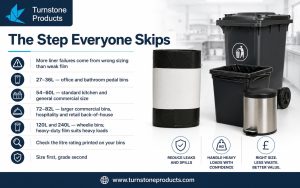
More liner failures come from wrong sizing than weak film. A liner too small for the bin gets stretched over the rim and tears at the corners under load; a liner too large wastes film and slumps into the waste.
Commercial liners are sized by bin capacity in litres, and matching is straightforward once you know your bins:
- 27–36L— office and bathroom pedal bins
- 54–60L— the standard kitchen and general commercial size
- 72–82L— larger commercial bins, hospitality and retail back-of-house
- 120L and 240L— wheelie bins; this is where heavy-duty film earns its keep, because full wheelie-bin loads are heavy and liners are lifted out
Measure or check the litre rating printed on your bins, then buy the liner sized to that rating — a correctly sized medium-duty liner routinely outperforms an oversized heavy-duty one. Businesses buying a Heavy duty bin liner perth wide should get sizing right first and grade second; a trade supplier will ask for your bin sizes before quoting for exactly this reason.
Matching Liners to the Business
Pulling strength and size together, here’s how the common Perth use cases spec out:
- Offices— light-duty liners in pedal-bin sizes for desks and bathrooms; medium-duty in the kitchen. Buying heavy-duty across an office is a common and pointless cost.
- Hospitality and kitchens— medium to heavy duty in 54–82L; wet, heavy food waste demands both strength and reliable seams, because a kitchen liner failure is a hygiene event, not just a mess.
- Cleaning contractors— a small standardised range (one light, one medium, one heavy) covering client sites, bought in carton volume for the van.
- Workshops, warehouses and trades— heavy or extra-heavy LDPE throughout; offcuts, packaging, metal and strapping will find every weakness in lesser film.
- Childcare and clinics— reliable medium-duty for general waste and dedicated strong liners for nappy and clinical-adjacent waste, where containment is non-negotiable.
The Double-Bagging Signal
If any bin in your business is routinely double-bagged, that’s not caution — it’s a specification failure and a doubled cost. The fix is one grade heavier, correctly sized, single-bagged. It’s cheaper and it works.
Buying at Trade: Cartons, Not Rolls
Liners are consumed relentlessly, which makes them one of the clearest wholesale wins in any consumables budget. Retail rolls carry the maximum markup in the category; trade cartons bring the per-liner price down dramatically, and volume pricing improves it further. The efficient pattern for Perth businesses: standardise on two or three liner specs matched to your actual bins, buy them by the carton from one local supplier, and put them on the same standing order as your other consumables. With next-day metro delivery available, there’s no need to warehouse a year’s supply — a few cartons of buffer and a reliable reorder rhythm covers it.
Why Choose Turnstone Products
Turnstone Products is a Perth-based B2B supplier stocking commercial bin liners across the size and strength range — from office pedal-bin liners through to heavy-duty wheelie-bin bags — alongside the chemicals, paper products, gloves and PPE that share the same delivery run. Orders go by quote form or phone rather than an online cart, which means you can describe your bins and waste and get the right spec recommended, not just the biggest one. Liners are sold by the carton at wholesale pricing that improves with volume, and next-day delivery across the Perth metro keeps busy kitchens, contractors and workshops stocked without hoarding. For businesses buying a Bin liner perth wholesale by the carton month after month, a trade account and standing order make the whole category automatic.
The Takeaway
Bin liners reward five minutes of specification: know your bin sizes in litres, match film grade to the worst waste in the bin, prefer LDPE where punctures are the risk, and stop double-bagging by buying one correct grade instead of two wrong ones. Then move the purchase to trade cartons from a local supplier and put it on a standing order. Done once, it’s a category you never think about again — which, for bin liners, is exactly the goal.