
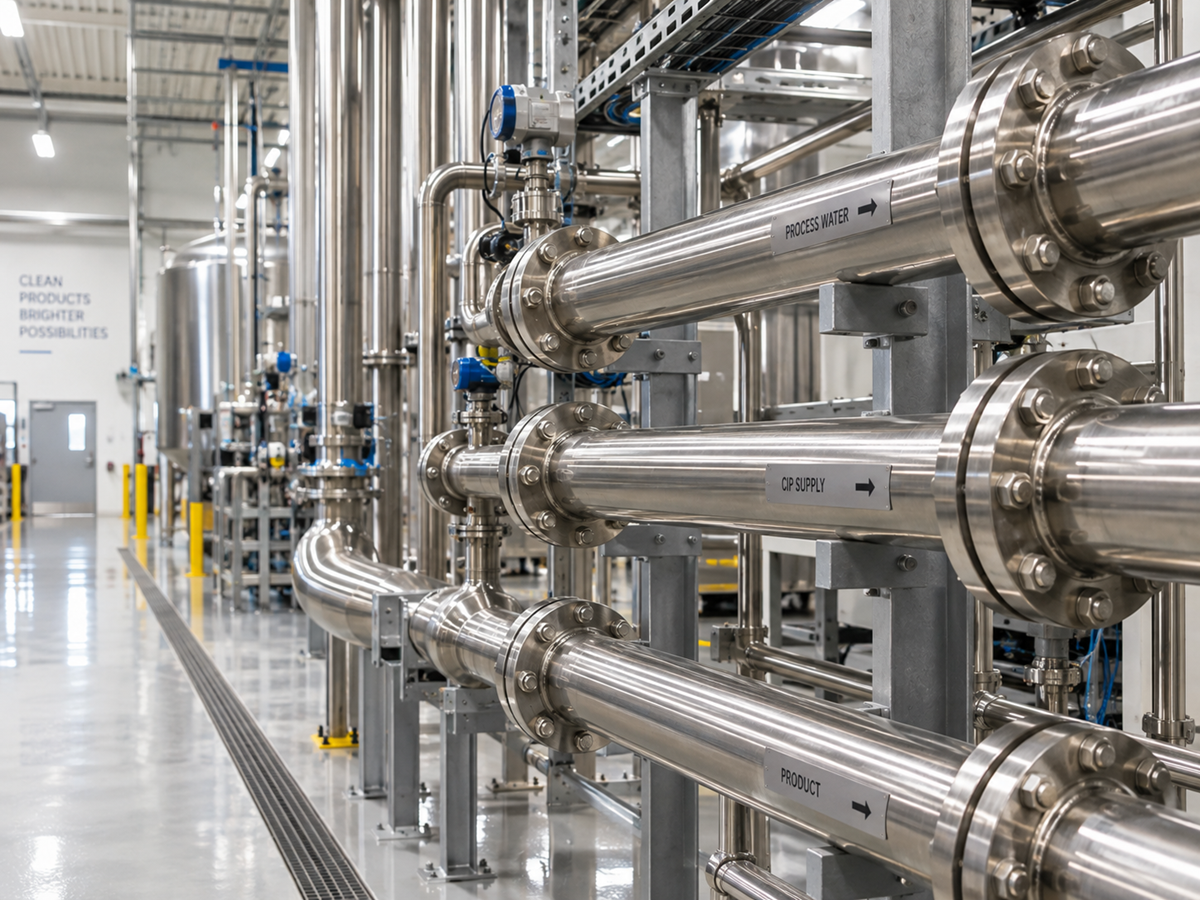

Specifying the right material is only part of building a stainless steel piping system that actually performs the way it’s meant to. Plenty of projects start with the correct grade and finish, only to run into problems further down the track because the system design itself layout, jointing method, thermal expansion allowance, or support spacing wasn’t given the same level of attention as the material selection. For engineers and plumbers planning a new installation or upgrade across industrial, food processing, or water treatment facilities, understanding how these design elements fit together is what separates a system that runs reliably for decades from one that develops recurring faults within a few years of commissioning.
This article looks past material grade and focuses on the practical system design decisions that determine how well a stainless steel piping installation actually performs once it’s in service.
Layout Planning: More Than Just Connecting Point A to Point B
The shortest route between two points isn’t always the best one when it comes to piping layout. Good design accounts for thermal movement, access for future maintenance, and the practical realities of how the space will be used once installation is complete.
Running pipework with adequate clearance from walls, structural elements, and other services makes future inspection and maintenance dramatically easier than a tightly packed installation where every repair requires disassembling adjacent pipework just to gain access. Similarly, planning isolation points at logical intervals rather than only at the very start and end of a run means future maintenance or modifications can be carried out on a section of the system without shutting down the entire installation.
For facilities with multiple processes drawing from a shared system, mapping out realistic peak demand across all connected points during the design phase avoids the common problem of a system that performs fine in isolation but struggles when several processes draw simultaneously.
Thermal Expansion: The Detail That Gets Overlooked
Stainless steel expands and contracts with temperature changes more than many engineers initially account for, and pipework that doesn’t allow for this movement is prone to stress-related failures at joints and fixed points over time. This becomes particularly significant in long straight runs, or in applications involving hot process fluids, steam, or outdoor installations exposed to significant daily temperature swings.
Expansion loops, offsets, or purpose-built expansion joints allow the pipework to absorb this movement without transferring excessive stress to fittings or support brackets. Fixed point locations where the pipe is rigidly anchored rather than allowed to slide need to be planned deliberately, working with the expansion allowance rather than fighting against it. Getting this wrong doesn’t always show up immediately; stress-related fatigue can take months or years to manifest as a failure, which makes it an easy detail to skip during design and only discover the cost of later.
Jointing Methods and When to Use Each
Stainless steel piping systems can be joined several ways, and the right choice depends on the application, required cleanliness standard, and whether future disassembly is likely.
Orbital or TIG welding produces the strongest, most hygienic joint and is the standard for food, beverage, and pharmaceutical applications where a smooth, crevice-free internal bore is essential to prevent bacterial harbourage. It requires skilled operators and appropriate purging equipment to avoid weld discolouration or contamination that can compromise both appearance and corrosion resistance.
Flanged connections suit points where future disassembly is anticipated, such as at pumps, valves, or equipment interfaces. They’re bulkier and carry a higher per-joint material cost than welding, but the maintenance access they provide often justifies the trade-off at strategic points in a system.
Compression and press-fit fittings offer faster installation for smaller diameter stainless steel piping runs, particularly in retrofit situations where hot works aren’t practical or permitted. They’re widely used in instrumentation and smaller utility lines where the strength of a welded joint isn’t strictly necessary.
Most substantial installations use a combination of these methods: welded for the bulk of the run, flanged at equipment connections, and mechanical fittings for smaller branch lines rather than committing to a single jointing method throughout the entire system.
Support Spacing and Preventing Sagging
Inadequate pipe support is a quietly common cause of long-term problems in stainless steel piping systems. Insufficient support spacing allows the pipe to sag between fixings over time, which can create low points where fluid pools rather than draining as intended, and puts uneven stress on joints that were designed for a straight, evenly supported run.
Support spacing needs to account for pipe diameter, wall thickness, the weight of the fluid being carried, and insulation if the line is lagged. Manufacturers typically publish recommended support spacing tables for different pipe sizes and schedules, and following these rather than estimating by eye is a straightforward way to avoid a problem that’s genuinely difficult to correct retroactively once the system is in service.
Comparing Stainless Piping Across Different Industry Applications
The design priorities for a stainless steel piping system shift considerably depending on what industry it’s serving. Food and beverage applications prioritise smooth internal finishes and orbital welding for hygiene compliance, often with sloped runs to fully drain during cleaning cycles. Water treatment applications focus more on pressure rating and external protection against buried or exposed environmental conditions. Chemical processing environments demand careful attention to compatibility between the specific stainless grade and the media being transported, since not every stainless alloy resists every chemical equally well.
Understanding which priorities matter most for a given application before finalising layout and jointing decisions prevents the common mistake of applying a generic design approach to a system with genuinely specific requirements.
Final Thoughts
A properly specified stainless steel piping system depends on far more than getting the material grade right. Layout planning, thermal expansion allowance, jointing method, and support spacing all interact to determine how the system actually performs once it’s carrying real loads over an extended service life. For engineers and plumbers approaching their next installation, treating system design as its own discipline alongside material selection rather than as an afterthought to it is what delivers a stainless steel pipe system that performs exactly as intended for the long haul.